

A seawall gives you years of warning before it fails — but only if someone knows what to look at. Jordan Marine Construction inspects seawalls, bulkheads, and waterfront retaining walls across Greater Houston, Lake Conroe, Lake Livingston, Clear Lake, and the Texas Gulf Coast, and delivers a documented condition report that tells you what is actually happening and what it will take to fix.
We inspect as builders, not as a sales call. Because we drive our own piling and build steel, vinyl, and timber walls in-house, we can tell the difference between a cosmetic crack and a wall that is quietly rotating waterward — and we will tell you when a wall is fine. Most owners call us after the sinkholes appear. An inspection is what keeps you from getting there.
Request Your Free EstimateOur Seawall Inspection Process
-
Waterside & Landside Walk
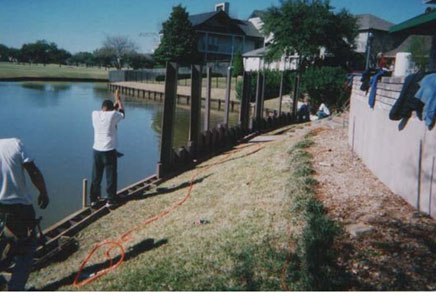
We assess the wall from both sides — by land and, where access requires it, by barge — photographing the wall face, cap, joints, and the ground behind it.
-
Structural Condition Check
We check plumb and alignment for rotation, probe for voids behind the wall, examine cap and whaler condition, assess tie-back and deadman performance, and evaluate steel section loss at the waterline.
-
Toe & Scour Assessment
We check the base of the wall for undermining from boat wake, waves, or current — the failure mechanism that most often causes a stable wall to suddenly lean.
-
Drainage Evaluation
We look at weep holes, backfill behavior, and where roof and yard runoff actually goes, since trapped hydrostatic pressure drives most failures in Houston clay.
-
Documented Condition Report
You receive a photo-documented report identifying the failure mechanism at work, its stage, and a prioritized scope separating urgent structural work from what can wait.
What an Inspection Actually Tells You
The report identifies which of the three failure mechanisms is at work — hydrostatic pressure, backfill washout, or anchor failure — and how far along it is. That determines whether you are looking at a targeted repair now or a full replacement later, and it gives you the evidence to plan and budget instead of reacting to a collapse. For HOA and POA boards, it provides documentation suitable for reserve planning and owner communication.
What We Actually Look At During a Seawall Inspection
A seawall inspection is not a glance from the dock. Nearly everything that determines a wall's remaining life is either below the waterline, behind the wall, or visible only as a pattern rather than a single defect — which is why walls routinely get declared fine right up until the year they are not.
We start with alignment, because rotation is the clearest early signal. A wall that is out of plumb, or whose cap line has developed a bow or a stair-step where sections have separated, is moving. Small amounts of lean can be stable and decades old; active rotation is a structure on a schedule. Distinguishing between them is a judgment call that comes from doing this on these specific waters, and it is the single most valuable output of an inspection.
From there: the cap, for cracking, spalling, exposed rebar, and settled sections that indicate lost bearing. The joints, for separation and for evidence that soil is passing through them. The ground behind the wall, probed for voids and walked for depressions, sinkholes, settling patios, and low spots along walkways — the surface evidence of backfill leaving. The tie-back system, assessed for corrosion and performance. On steel, the waterline band where section loss concentrates. On timber, the splash zone and fastener points where rot begins, plus borer damage in brackish and salt water, which hollows a member from inside while the surface still looks sound. And the toe, checked for the scour that undermines walls from below.
Reading the Failure Mechanism, Not the Symptom
The purpose of the inspection is to answer one question: which failure mechanism is at work, and how far along is it? There are three, and they call for completely different work.
Hydrostatic pressure is water trapped in saturated soil behind the wall with nowhere to drain, pushing outward after every heavy rain — and Houston clay both holds water and swells against the wall when wet. It presents as bowing, cracking, and progressive lean, and the fix is drainage. Backfill washout is soil escaping through joints, cracks, or under the toe into the water, hollowing voids that surface as sinkholes and settlement. It presents as depressions behind an otherwise sound-looking wall, and the fix is sealing the escape path and filling the voids. Anchor failure is tie-back rods and deadmen corroding or pulling loose, letting the wall rotate waterward each season. It presents as lean and joint separation, and the fix is anchor restoration.
The reason the distinction matters financially is that these repairs have very different costs, and the wrong one does nothing. Filling sinkholes on a wall whose tie-backs have failed feeds the lake more of your yard. Injecting foam behind a wall that is rotating hides the cause for a season. Restoring anchors on a wall that is bleeding backfill through an open joint leaves the joint open. A wall frequently has more than one mechanism running at once, and the inspection is what tells you which combination you are paying to fix.
When to Get a Seawall Inspected
Annually is a reasonable baseline, and after any major storm, flood, or extended high-water event. Beyond that schedule, there are triggers that justify an inspection immediately: new depressions or sinkholes in the lawn behind the wall, cracks appearing or widening in the cap, a visible lean or bow that was not there before, gaps opening at panel joints, soil visibly washing out at the toe after rain, gates or fences along the wall that no longer line up, and settling in patios, walkways, or sprinkler lines near the wall.
There are also transaction triggers. If you are buying waterfront property, the condition of the seawall is a material financial fact that a standard home inspection will not evaluate competently — a wall nearing replacement is a substantial liability that should be understood before closing, not discovered afterward. If you are selling, a documented condition report can protect a negotiation from speculation. And if you are on an HOA or POA board, community bulkhead systems typically need documented condition information to plan reserves, prioritize phasing across properties, and communicate credibly with owners about assessments.
The economic argument for inspecting early is straightforward: every one of the three failure mechanisms is dramatically cheaper to arrest in its early stage than to repair after it has compounded. A joint sealed before it passes significant soil costs a fraction of filling the voids, restoring the grade, and re-anchoring a wall that rotated because the backfill supporting it left. Walls give years of warning. The inspection is how you collect it.
What You Get, and Who We Inspect For
You receive a photo-documented condition report: what we found, which failure mechanism is at work, what stage it has reached, and a prioritized scope that separates urgent structural work from what can reasonably wait a season or be phased across budgets. Where the honest answer is that the wall is in good condition and needs nothing, that is what the report says — we would rather build a relationship with a waterfront owner than sell an unnecessary rebuild.
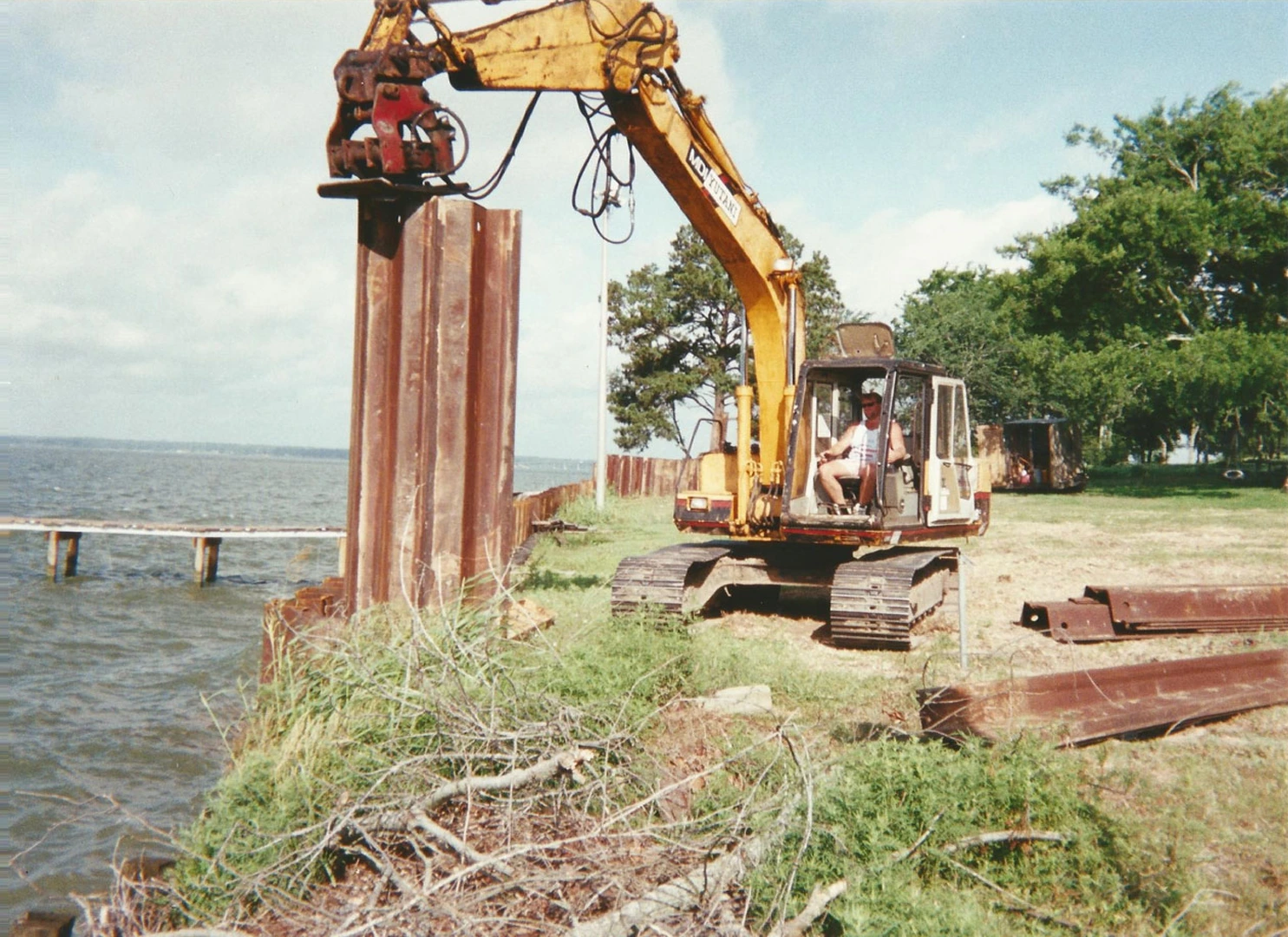
We inspect walls we did not build, which is most of them, and we assess the structure on its merits. Because Jordan Marine Construction builds seawalls and bulkheads in steel, vinyl, and treated timber and drives its own piling from barge and land, our assessment is not steered toward the one product a crew happens to carry — and our barge-mounted equipment reaches walls and toe conditions that cannot be evaluated from land.
We work with residential waterfront owners, HOA and POA boards, lake communities, marinas, and commercial property managers across Greater Houston, Lake Conroe, Lake Livingston, Lake Houston, Clear Lake, Kemah, Seabrook, League City, Galveston Bay, and the surrounding Gulf Coast. For community-scale systems we can assess an entire shoreline rather than a single lot, which is what a board actually needs to plan phasing and reserves. Active failures get priority scheduling.
Related Projects

Where We Build Seawall Inspection
We build seawall inspection for waterfront communities across Greater Houston, Lake Conroe, Lake Livingston, and the Texas Gulf Coast. A few of the areas we serve:
Don't see your area? View all service areas or contact us.
Seawall Inspection FAQs
How often should a seawall be inspected?
Annually is a reasonable baseline for most walls, and after any major storm, flood, or unusually high-water event. Older timber walls, walls with a known history of settlement, and walls with any visible lean warrant more frequent attention. Catching a failure mechanism early is the difference between a repair and a rebuild.
What does a seawall inspection cost?
Our assessments are free for property owners considering repair work — we would rather look at a wall early than be called after the yard starts collapsing. For HOA and POA boards needing formal documentation for reserve studies or owner meetings, contact us to discuss the scope of report you need.
What are you actually looking for?
Rotation and plumb, cap and whaler condition, joint separation, voids and settlement behind the wall, tie-back and deadman performance, section loss on steel at the waterline, rot and borer damage on timber, and toe scour at the base. The visible crack is rarely the problem — it is evidence of one.
Can you inspect a seawall you did not build?
Yes, and most of the walls we inspect were built by someone else. We assess the structure on its merits and report what we find, including when the honest answer is that the wall is in good shape and needs nothing.
Do you inspect seawalls for HOA and POA boards?
Yes. Community-scale bulkhead systems are a significant part of our work, and boards typically need documented condition information to plan reserves, prioritize phasing, and communicate with owners. We can assess an entire community shoreline rather than a single lot.
How do I find a seawall inspection near me?
Look for a licensed, insured marine contractor that builds seawalls in multiple materials and has barge access — much of what determines a wall's remaining life is below the waterline or at the toe and cannot be evaluated from land. A contractor that installs only one product has an incentive to diagnose every wall as needing that product. We inspect across Greater Houston, Lake Conroe, Lake Livingston, Lake Houston, Clear Lake, Kemah, Seabrook, League City, Galveston Bay, and the surrounding Gulf Coast communities.
Should I get a seawall inspected before buying waterfront property?
Yes. A seawall nearing the end of its life is a substantial financial liability, and a standard home inspection will not evaluate one competently — the condition indicators are below the waterline, behind the wall, and in patterns rather than single defects. Understanding the wall's actual condition before closing is far better than discovering it afterward, and a documented report gives you something concrete to negotiate with.
Can a seawall look fine and still be failing?
Routinely. Marine borers hollow timber members from the inside while the surface looks sound. Steel loses section in a narrow band at the waterline that is invisible from the deck. Backfill can be escaping under the toe for years before the first sinkhole appears at the surface. And a wall can be rotating slowly enough that no single year looks different from the last. Those are exactly the conditions an inspection exists to catch.
Do you inspect bulkheads and retaining walls too?
Yes. Bulkheads, seawalls, and waterfront retaining walls share the same three failure mechanisms — hydrostatic pressure, backfill washout, and anchor failure — and the same inspection methodology applies. We also assess associated structures during the same visit where it makes sense, including dock pilings, boat lift framing, and toe protection.
What happens after the inspection?
You get the report and decide. There is no obligation to have us do the work, and if the wall needs nothing we will tell you that. If repairs are warranted, the prioritized scope becomes the basis for a free itemized estimate, which lets you phase work across budgets or seasons where the condition allows it. Active failures we flag for priority scheduling, because a wall that has started to move accelerates with every storm.
Related Services
.webp)
Get a Free Seawall Inspection Estimate
Tell us about your project and we'll provide a detailed, no-obligation estimate. Serving Greater Houston, Lake Conroe, Lake Livingston, and the Texas Gulf Coast.