

For the most demanding marine applications — high-traffic commercial waterfronts, exposed coastal sites, and structures that must outlast everything around them — concrete is the endgame material. Jordan Marine Construction builds concrete marine structures, caps, and seawall systems across Greater Houston and the Texas Gulf Coast, backed by 40+ years of construction experience across two families of builders.
Concrete's role in marine construction is usually structural partnership: concrete caps crowning steel or vinyl sheet walls, concrete abutments and footings under heavy structures, and full concrete seawall systems where wave energy and service life demand it. We engineer and build each application to its loads and exposure.
Request Your Free EstimateOur Concrete Dock & Seawall Construction Process
-
Site & Load Assessment
We evaluate exposure, soils, and the loads the structure must carry to determine where concrete serves the design.
-
Engineering & Permitting
Structural design and reinforcement specs are drawn to the application, and we manage the authority review.
-
Foundation & Forming
Driven foundations, forms, and reinforcement are placed to the engineered design.
-
Pour, Cure & Finish
Marine-appropriate concrete is placed, cured, and finished — caps, walls, and surfaces ready for decades of service.
Materials & Engineering
Marine concrete work uses appropriate mix designs and reinforcement detailing for the splash-zone environment, over driven foundations. Caps for sheet-pile walls, structural footings, and seawall systems are engineered to the retained loads and wave exposure of the specific site.
Concrete's Role in Marine Construction: Permanence Where It Counts
Concrete is the material you choose when the structure must simply never be the problem again. It doesn't rot, burn, corrode, or feed borers; it gains strength for years after placement; and properly reinforced and detailed for the splash zone, it delivers service lives measured in generations. The trade is cost and commitment — concrete is the most expensive system to place and the least forgiving to relocate — which is why its highest use is where loads, exposure, or consequence justify permanence.
In our region's marine work, concrete most often appears in structural partnership: reinforced caps crowning steel and vinyl sheet-pile walls (stiffening the wall, tying the tie-back system together, and finishing the top as a walkable edge), abutments and footings under bridges and heavy structures, and full seawall systems on exposed commercial and coastal sites where wave energy retires lighter materials early.
Marine concrete is a specialty within a specialty: mix designs and reinforcement detailing must anticipate the splash zone — the wet-dry cycling band where chlorides drive rebar corrosion and spalling in poorly detailed work. Cover depths, reinforcement choices, and curing discipline are what separate fifty-year marine concrete from twenty-year regret. With 40+ years of construction experience across two building families, we detail for the former.
Caps, Seawalls, and Heavy Foundations
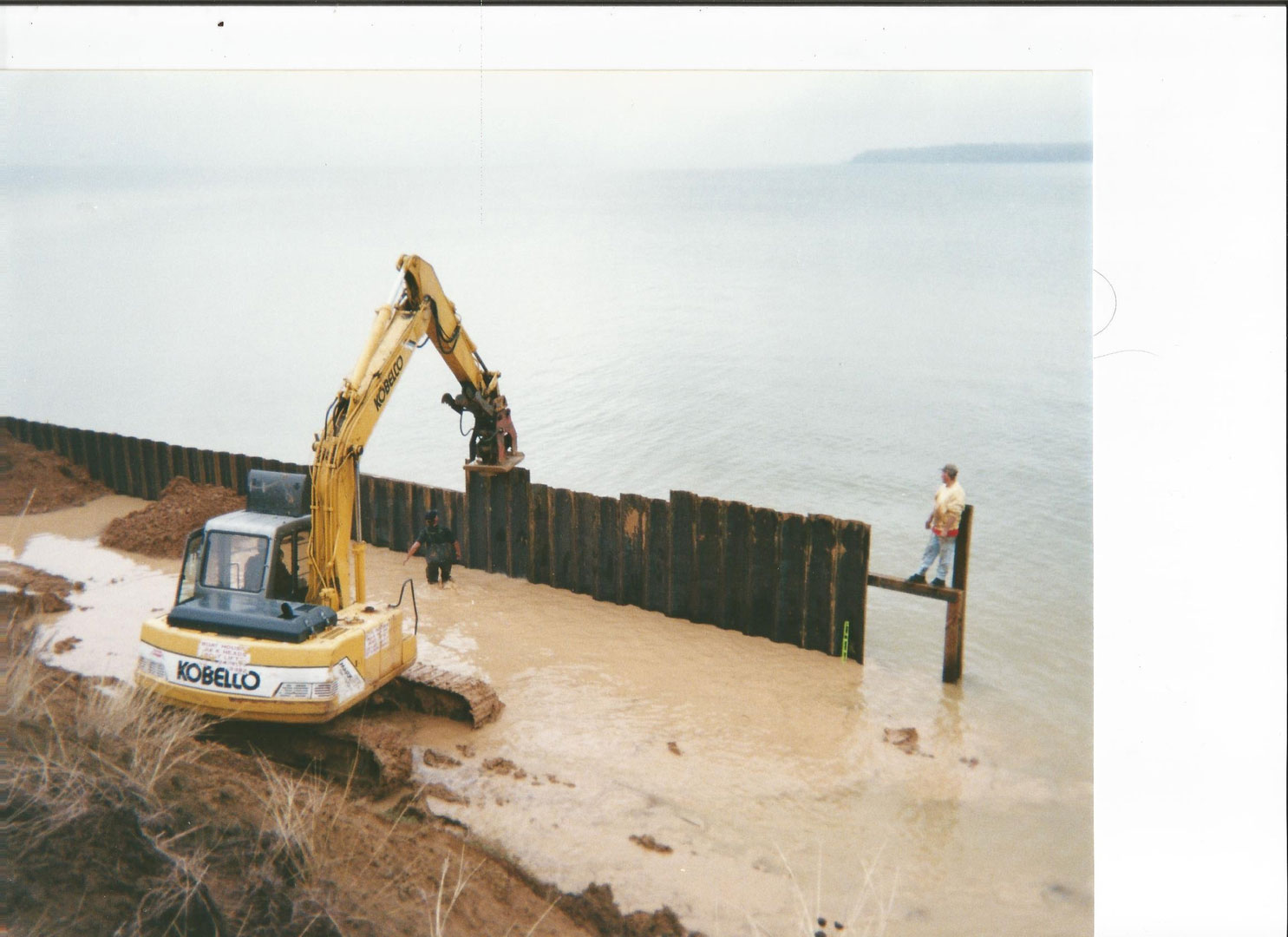
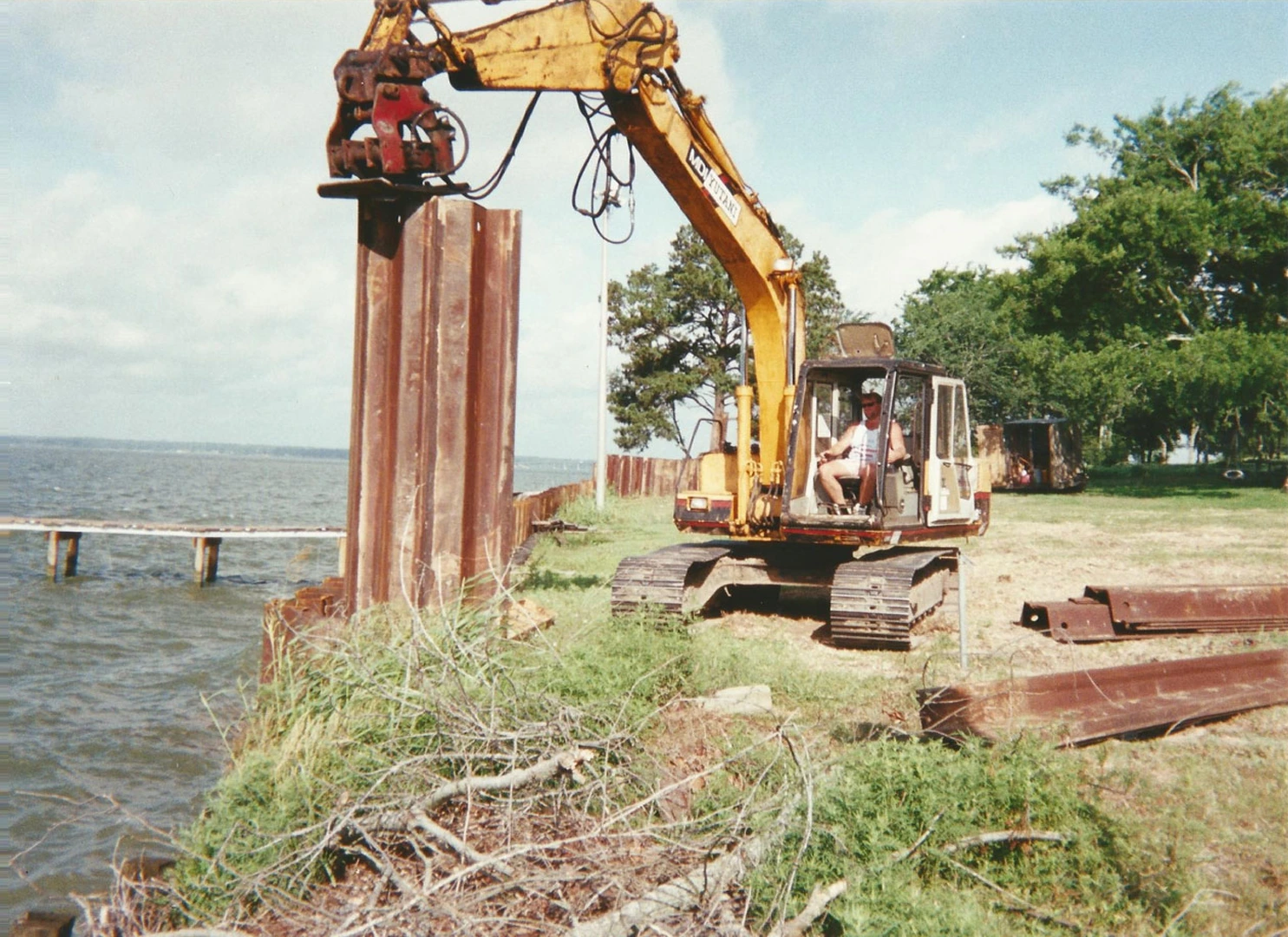
The concrete cap is the workhorse application. A reinforced cap on a sheet-pile bulkhead does four jobs at once: it locks the sheet tops into one continuous structural member, ties the tie-back anchors into the whole wall rather than individual sheets, armors the wall's most exposed edge, and gives the shoreline a finished, walkable crown. On new walls we design the cap in; on repairs, a new cap over a sound wall is one of the highest-value upgrades available.
Full concrete seawalls suit high-consequence sites: commercial waterfronts, exposed bay shorelines, and installations where the owner wants the erosion question answered permanently. These are engineered structures — foundation, reinforcement, drainage, and toe protection designed to the site's wave climate and soils — and they're typically paired with riprap toe armor to break wave energy before it works on the wall.
Below the waterline, concrete serves as the foundation class for the heaviest work: bridge abutments, structural footings, and ramp structures that carry vehicle loads into the water. Like everything we build at the shoreline, concrete work is permitted through the controlling authority — SJRA, TRA, City of Houston, or USACE/GLO — and sequenced around water levels and weather windows.
Related Projects
Where We Build Concrete Dock & Seawall Construction
We build concrete dock & seawall construction for waterfront communities across Greater Houston, Lake Conroe, Lake Livingston, and the Texas Gulf Coast. A few of the areas we serve:
Don't see your area? View all service areas or contact us.
Concrete Dock & Seawall Construction FAQs
When is concrete worth it over steel or vinyl?
Where service life and load capacity trump initial cost: commercial seawalls, high-exposure coastal sites, and caps that armor sheet walls. For most residential shorelines, vinyl or steel with a concrete cap hits the value point — we price the options honestly.
Do you build concrete caps on existing bulkheads?
Yes. A reinforced concrete cap stiffens the wall, ties the tie-back system together, and finishes the top with a durable walkable edge — a common upgrade during bulkhead repair or replacement.
How long does a concrete seawall last?
Engineered and detailed correctly for the splash zone, generations — concrete is the longest-lived system we build. Service life hinges on reinforcement detailing and drainage more than the concrete itself; walls fail at corroding rebar and trapped water, both preventable at design.
Why do concrete seawalls crack and spall?
Chloride-driven rebar corrosion in the splash zone: water reaches under-covered steel, rust expands, and concrete spalls off. It's a detailing failure — adequate cover, correct reinforcement, and good curing prevent it. Assessment tells us whether an existing wall's spalling is cosmetic or structural.
Is a concrete cap worth adding to my existing bulkhead?
If the wall is sound, very often yes — the cap stiffens the whole wall, integrates the tie-backs, and armors the top edge, typically extending the wall's life meaningfully while upgrading how the shoreline looks and walks. We assess the wall first; a cap on a failing wall wastes money.
Concrete or steel for a commercial seawall?
Both are commercial-grade answers; the choice follows site economics and exposure. Steel installs faster and handles tall retained heights efficiently; concrete offers the longest life and lowest maintenance where wave energy is punishing. Frequently the answer is both — steel sheets with a concrete cap.
Related Services
Get a Free Concrete Dock & Seawall Construction Estimate
Tell us about your project and we'll provide a detailed, no-obligation estimate. Serving Greater Houston, Lake Conroe, Lake Livingston, and the Texas Gulf Coast.